Japan’s Shogunate Defines Dokdo Island (松島 Matsushima) as Part of Chosun (Korea)
During the early 19th Century the Japanese Shogunate strictly enforced an isolationist policy and passage to foreign lands was controlled or forbidden without special voyage passes. However a man named Aizuya Hachiemon ignored this ban and sailed to Ulleungdo without permission. This resulted in him being executed.
Aizuya Hachiemon (?津屋八右衛門, 1798-1836) operated a cargo-vessel business in Hamada, Iwami (石見?濱田 today’s Hamada in Shimane) under the feudal domain of Hamada. To help the ailing financial situation of his domain, he ignored the travel ban to Takeshima (Ulleundo) and conducted illegal contraband trade. Some say that he even traveled to Southeast Asia. Okada Tanomo (岡田?母), who was the chief retainer of the domain, and Hashimoto Sahei (橋本三兵衛), a financial official, silently approved Yaemon’s illegal activities since the profits from the trade was enormous and actually saved the domain from going bankrupt.
Japanese Takeshima lobbyists insist
“…The 1836 incident is important in the Dokdo/Takeshima debate because it shows that although travel to Takeshima (Ulleungdo) was banned, travel to Matsushima (Liancourt Rocks) was apparently not since Hachiemon traveled to Takeshima under the pretense of going to Matsushima…” From this belief, some Japanese go a step further stating
“…because there was no travel ban, Matsushima (Dokdo) was thought to be part of Japan….” These claims can be proven as false.
However, some Korean historians claim that Japan had previously given up claim to both Ulleungdo and Liancourt Rocks. It does appear the 1836 incident is evidence that this was in fact true. When we view all of the evidence surrounding the “Takeshima Incident” it’s apparent the Japanese involved did regard Matsushima-松島 (Dokdo) as Chosun land.
Aizuya Hachiemon’s testimony reads in part as follows:
“…One day in August 1831, I took a letter of my idea (?存書) to the financial officer of Hamada Domain, Mr. Murai Ogiemon (村井荻右衛門), who was stationed in Edo (江?:Tokyo). In that letter, I wrote the following:”There is another small island called Matsushima (Liancourt Rocks) 70 to 80 ri north of Iwami (石見), and I think that it is regrettable to leave alone these two completely vacant islands, Takeshima and Matsushima. If we harvest the trees of the island or fish, it would benefit not only me, but also the nation (Hamada). We can discuss the percentage of commission for Lord Suoh (周防守:Matsudaira Yasuto) later, but I hope we can make an informal agreement first..
I asked Hashimoto to get permission from Chief Retainer Okada (岡田), so that I could make a voyage. I received a letter from Mr.Murai in Edo. It said that I should not go to Takeshima (Ulleungdo) since it was not decided if it belonged to Japan or not. Since I did not expect that kind of reply, I was disappointed and asked Hashimoto again to take the letter to Mr. Okada, so that we could get permission from him. Later, I went to Hashimoto’s place to see how things went, and he told me that Mr. Murai’s letter must have been implying that we go to Matsushima instead of Takeshima. He also said that Matsushima was probably too small to make a large profit, so we should just tell the officials of Hamada Domain in Edo that we were going to Matsushima (Dokdo), but go to Takeshima, instead…”
As we read there is no statement the Japanese considered Matsushima to be Japan’s territory at all. Rather Japanese historians simply state because Aizuya Hachiemon voyaged there, Japan considered Matsushima (Dokdo) their island. Perhaps Aizuya Hachiemon figured he could escape punishment because there was no specific travel ban to Matsushima. There is also a distinct possibility Aizuya Hachiemon simply lied about receiving consent to (unsuccessfully) avoid being executed.
But did those Japanese who engaged in the clandestine voyages to Ulleungdo and Dokdo really consider the islands as Japanese?
Related Maps to Hachiemon’s Takeshima 竹島 (Ulleungdo) Trespassing Incident
More important than Aizuya Hachiemon’s tainted testimony, is his related map attached to the investigation of the event. This colour-coded map shows exactly the territorial perceptions of those who illicitly voyaged around Japan in the years prior to the Meiji Era. Next to the map is a modern map labelled for reference. The red coloured lands on this map are Korean territory and we can see 竹島 (Takeshima-Ulleungdo) and 松島 (Matsushima) are clearly labelled as Chosun land. Aizuya Hachiemon who was a seafarer and international trader drew this map, and he knew full well which lands were both Korean and Japanese. He believed Takeshima (Uleungdo) and Matsushima (Dokdo) were both Korean territory. This was because Japan had previous declared both Ulleungdo and Dokdo were off limits to Japanese as declared in 1695. (
see Tottori Bafuku Records of 1695 )
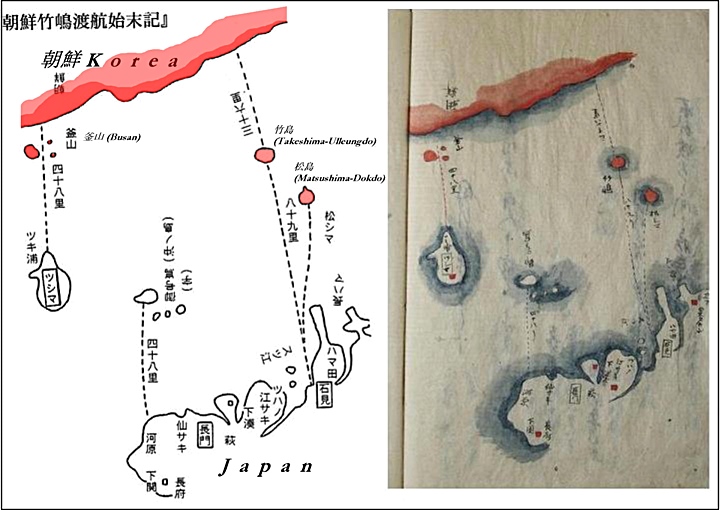
The image above left is a labelled map for reference. To the above right is Aizuya Hachiemon’s map drawn during the investigation of his trespassing on Korea’s Ulleungdo Island (Takeshima 竹島). This map clearly shows Ulleungdo (竹島) and Dokdo (松島 ) as Chosun (Korean) land. click the map for larger image.
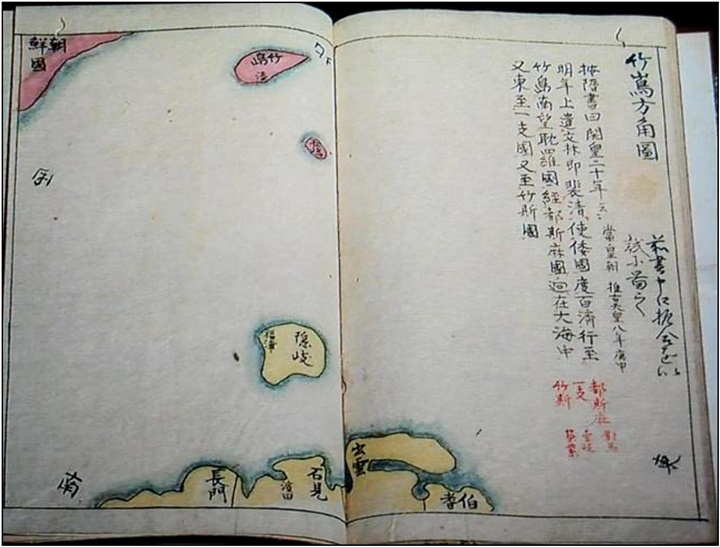
Another map that accompanied the details of Hachiemon’s trespassing and trial on Chosun’s Ulleungdo. This map also shows the Japanese Shogunate extended the travel ban to Dokdo and considered both Ulleungdo (竹島) and Dokdo (松島) as Korean territory.
The Japanese Report on the Takeshima – 竹島 (Ulleungdo Island) Trespassing Incident
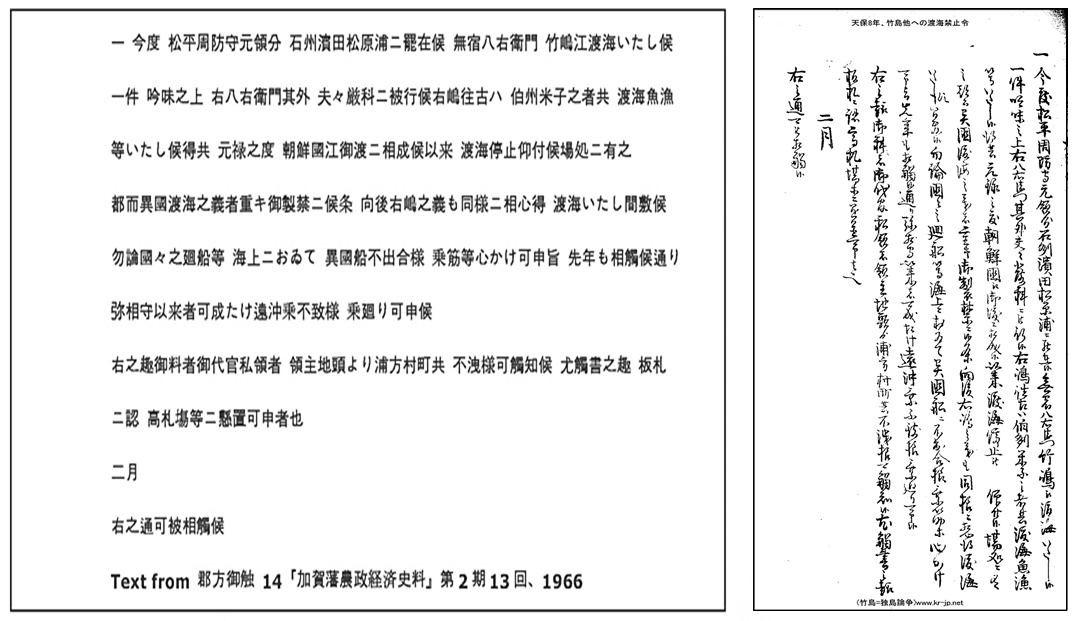
The Japanese document below is a historical record related to the trial of Aizuya Hachiemon. This record strongly affirms what the above map shows us. We can read that the Shogunate’s travel ban on Ulleungdo extended to Chosun’s Dokdo (Matsushima – 松島)
The above images are the Japanese records of Hachiemon’s Trespassing Incident. Above left is the text form and to the right are the original written scipt. The translation is below.
“…Recently after reviewing Azuya Hachiemon’s illegal trespassing on 竹島-Takeshima (Ulleungdo). He is known to be in the fuedal domain of Matsudaira Yasuto, in 石州 Hamada,. but having no permanent residence. All of the others involved were severely punished along with Azuya Hachiemon, to the right. As to the island on the right, people from (伯耆) Yonago City used to voyage there but it has been banned since the Genroku Era, during which it was ceded to the Chosun government.
Voyaging to foreign lands is strictly forbidden. From now on, the island on the right is prohibited as well. Although it has been declared before that voyaging ships are not to come in contact with foreign vessels, once again, from this time forward sailing far out to sea must be avoided.
This message must be written on a board and be displayed to inform our people everywhere…”
Azuya Hachiemon’s Takeshima Incident A Conclusion Based on the Evidence
Why are these historical records important?
The above data is very significant because it sheds light on the very secretive activities of those who violated the Shogunates travel ban on both Takeshima (Ulleungdo) and Matsushima (Dokdo) Japan’s current claim to Takeshima is partly based on the unauthorized voyages of private individuals such as the Oya and Murakawa families of the Oki Islands and Shimane Prefecture. In the past, Japanese historians have asserted the travels by these people were evidence of Japan’s sovereignty over the islands. As shown, this is not the case.
First the attached map shows both Takeshima (Ulleungdo) and Matsushima (Dokdo) were thought to be Korean land. Second, the related paper, shows the travel ban issued by the Shogunate involved more than just Chosun’s Ulleungdo but also Matsushima-松島 (Dokdo Island).
Which makes us wonder, why didn’t the Japanese Shogunate explicitly forbid passage to Matsushima as well in the first place?
Well, as part of Azuya Hachiemon’s testimony shows us, it was common knowledge sailing to Matsushima(Dokdo) as a sole destination was pointless. From the departure point of Japan’s Yonago, Dokdo Island was a six day return voyage through very heavy seas, Dokdo had no fresh water or shelter. But most of all Dokdo has no resources such as lumber or fishing to harvest. This is why there are no records of Japanese ever voyaging to Dokdo as a destination.
The Shogunate considered Ulleungdo and Dokdo as Chosun (Korean) land and had a strict policy on foreign travel. This position would drastically change when the expansionist Meiji Government would come into power in the latter 19th Century. So much so, even Korea’s Ulleungdo Island would be overwhelmed by hundreds of illegal Japanese settlers.